🧵 The Ultimate Enterprise Guide to Authenticating Leather: Professional & Synthetic Analysis
🌍 Introduction: Navigating a Complex Leather Market
Finding high-quality, authentic leather in today’s market requires more than visual inspection—it demands technical understanding, material science awareness, and procurement discipline. With the rise of synthetic alternatives such as PU (polyurethane), faux, and so-called “vegan” leather, the distinction between genuine and artificial materials has become increasingly blurred.
For enterprises involved in sourcing leather for retail, upholstery, automotive, or luxury goods, misclassification can lead to quality failures, reputational risk, and reduced product lifecycle value. This guide provides a structured, professional framework to evaluate leather authenticity through physical, chemical, and performance-based analysis.
1. Understanding Leather vs Synthetic Materials
At its core, authentic leather is a biological material derived from animal hides, primarily composed of collagen fibers arranged in a complex, interwoven structure. This natural composition gives leather its durability, breathability, and aging characteristics.
In contrast, synthetic leather is typically made using polyurethane (PU) or polyvinyl chloride (PVC) layered over a fabric base. While engineered to mimic leather’s appearance, synthetics lack the fibrous depth, thermal adaptability, and longevity of genuine hides.
Enterprise Insight
Understanding this distinction is critical for:
- Product durability forecasting
- Warranty and lifecycle planning
- ESG and sustainability positioning
2. Structural Integrity & Surface Grain Analysis
✔ Natural Leather Characteristics
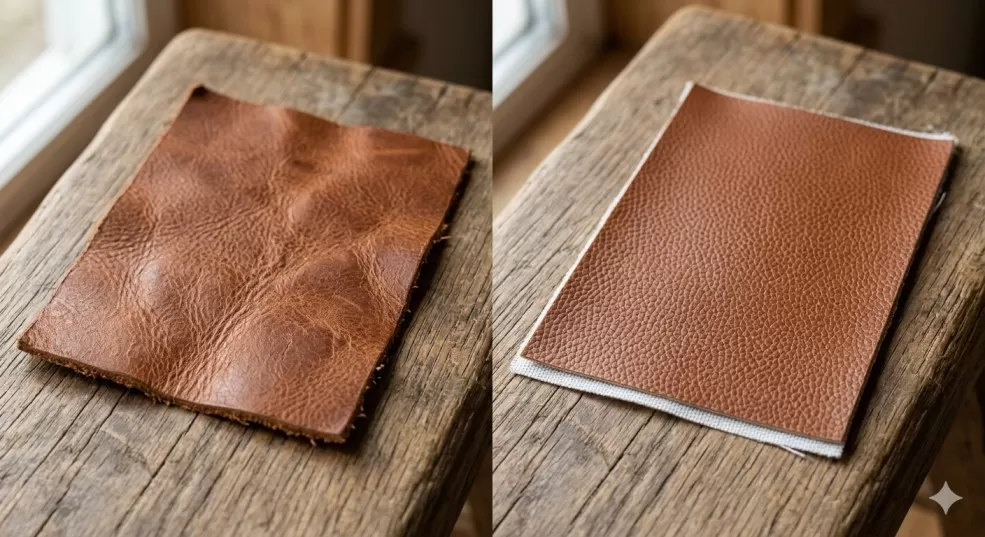
- Irregular Pore Distribution: Authentic leather exhibits random, non-repeating pores and markings.
- Surface Imperfections: Scars, wrinkles, and natural variations indicate genuine origin.
- Fibrous Cross-Section: When cut, leather reveals a dense, suede-like fiber network (corium layer).
❌ Synthetic Leather Indicators
- Uniform, Repeating Patterns: Machine-embossed grain appears overly consistent.
- Layered Construction: Visible textile or mesh backing beneath a plastic coating.
- Artificial Finish: Surface often looks overly smooth or glossy.
Enterprise Application
Use magnification tools and edge inspection protocols during quality control to validate material authenticity at scale.
3. Physical Response Testing
The “Thumb” or Wrinkle Test
- Original Leather: Compresses and forms fine wrinkles, then recovers naturally.
- Synthetic: Resists wrinkling or behaves like rigid plastic.
Water Absorption Test
- Original Leather: Absorbs moisture due to natural porosity, temporarily darkening.
- Synthetic: Repels water; droplets bead and roll off.
Enterprise Application
These quick, non-destructive tests are valuable for on-site supplier audits and batch inspections.
4. Sensory & Thermal Evaluation
Scent Profile
- Original Leather: Distinct earthy, organic aroma from natural tannins and proteins.
- Synthetic: Chemical or plastic-like odor.
Heat Conductivity
- Original Leather: Warms quickly and adapts to body temperature.
- Synthetic: Feels cold or clammy; retains ambient temperature.
Fire Test (Controlled/Professional Only)
- Original Leather: Smells like burnt hair; chars without melting.
- Synthetic: Melts, emits plastic odor, and may ignite.
Enterprise Application
Sensory evaluation is particularly useful in incoming material inspections and supplier validation processes.
5. Decoding Leather Grades & Industry Terminology
One of the most critical challenges in enterprise procurement is understanding leather grading terminology, which is often misused in marketing.
🥇 Full-Grain Leather
- Highest quality; retains the entire grain layer
- Extremely durable; develops natural patina over time
- Ideal for luxury goods and premium applications
🥈 Top-Grain Leather
- Sanded to remove imperfections
- More uniform and flexible but slightly less durable
- Common in high-end commercial products
⚠️ Genuine Leather
- Derived from lower layers (split leather)
- Heavily processed and embossed
- Real leather, but lowest quality tier in the “genuine” category
❌ Bonded Leather
- Made from shredded leather fibers bonded with polyurethane
- Low durability and prone to peeling
- Typically used in low-cost furniture and accessories
Enterprise Insight
Misinterpreting these terms can lead to overpaying for low-grade materials or misaligning product positioning with customer expectations